
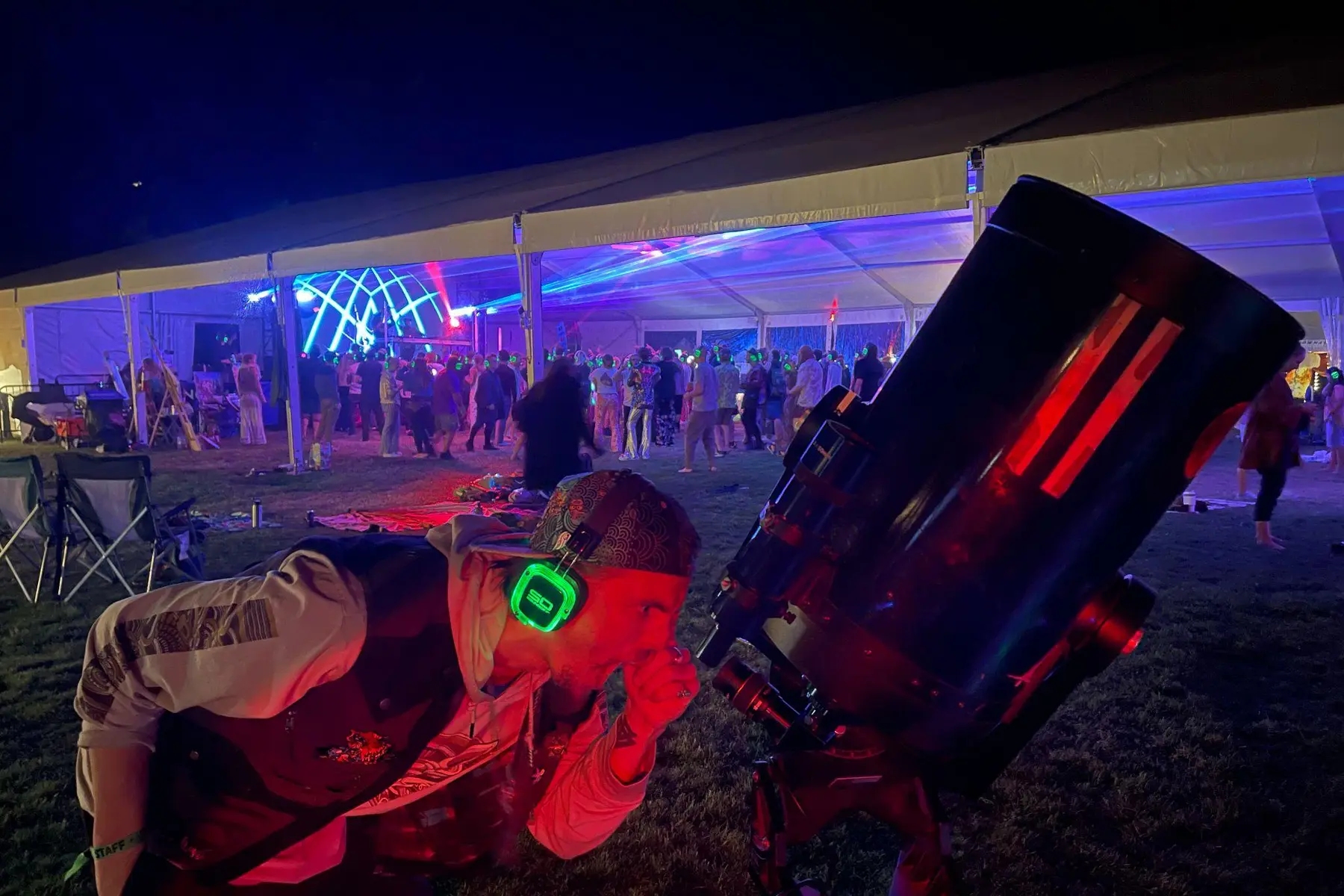
Stars Above Aspen is not a standard telescope tour. It is a four-hour destination event reached by gondola, with daytime and twilight activities, food service, multiple education partners and guided telescope stations after dark.
The astronomy had to fit a wider program
The official 2026 schedule combined sunset yoga, cosmic crafts, a Fiske Planetarium mini dome, an interactive mural, solar viewing, science questions and nighttime telescope stations. Guests could build their own evening rather than move through one fixed sequence.
AstroTours' documented role was astronomy-team support within that larger event. It should not be mistaken for ownership of the event or every activity. That distinction matters because effective collaboration begins with clarity about what each partner is responsible for delivering.
Capacity changes telescope operations
At a large event, equipment selection is partly about throughput. A beautiful target is not useful if only a handful of guests can reach it during the available darkness. Several stations, clear lines, short explanations and astronomers who can reset the view quickly are essential.
The best station mix gives people different experiences rather than duplicating one object ten times. Bright showpieces can handle fast-moving queues while a specialist station supports deeper questions for guests who want to linger.
Mountain transport sets hard boundaries
The last gondola up and down, cooling temperatures and the transition from solar to nighttime viewing create non-negotiable timing. Setup has to be complete before the public flow reaches the stations, and pack-down must respect the mountain's transport and venue operations.
This is why destination astronomy must be designed with operations teams, not added at the end of an event plan. The sky may be the attraction, but transport determines whether the experience can happen safely.
The destination lesson
For a large event, make astronomy a network of complementary stations and experiences. Define each partner's scope, calculate the number of meaningful guest interactions possible, and work backward from the site's transport and closing constraints.
For other destinations
4 lessons from the work
- 01Define partner roles visibly and precisely.
- 02Design telescope stations for both variety and throughput.
- 03Use daytime and twilight activities to extend the program window.
- 04Treat transport cutoffs as core design inputs.
References
Original sources
Aspen Snowmass independently confirms the 2026 event, elevation, schedule and partner-led activity mix. AstroTours' support role is documented in supplied company records and is deliberately labeled as support, not event ownership or endorsement by Aspen Snowmass.